
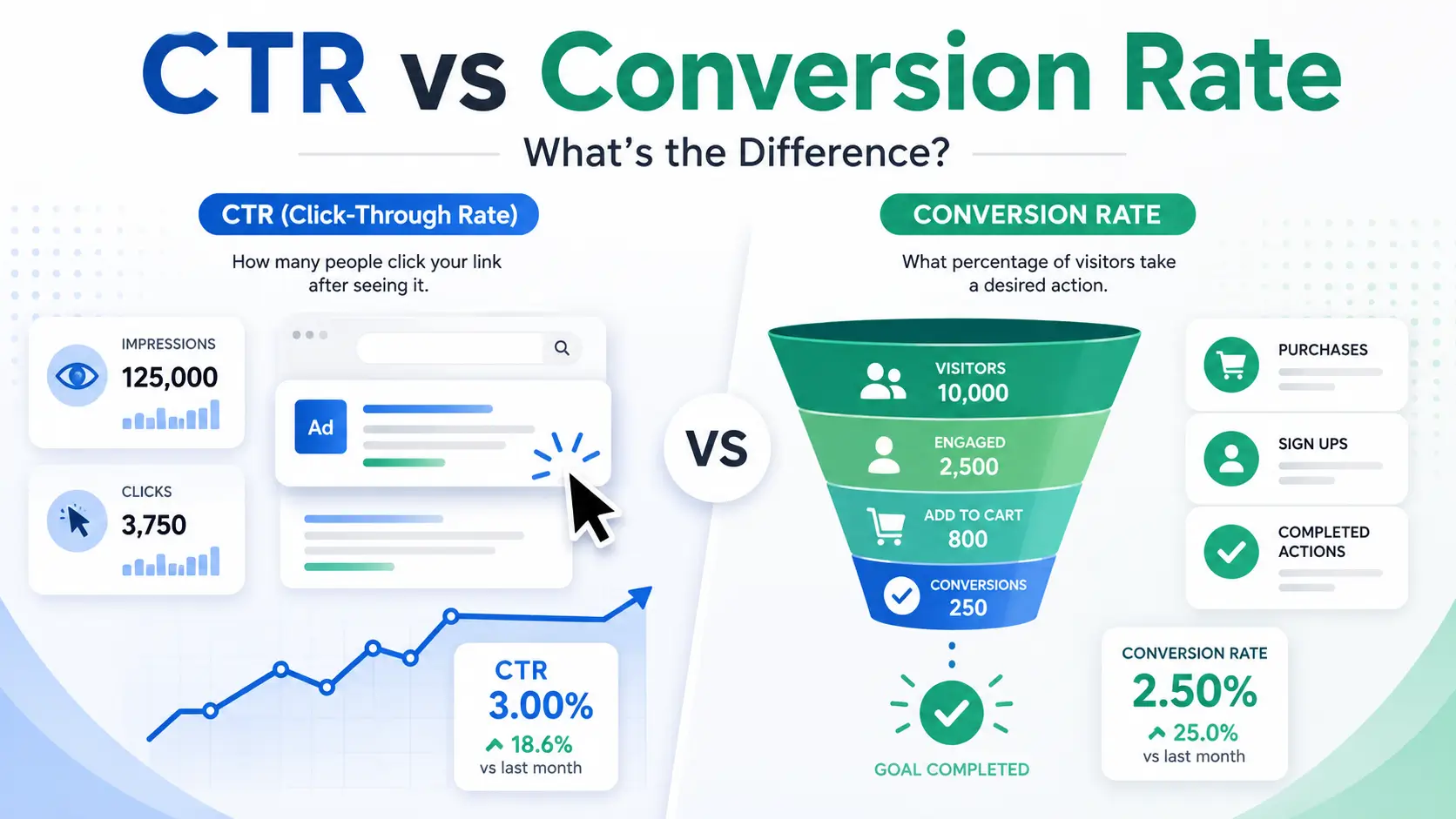
CTR vs Conversion Rate is an important comparison for marketers because these two metrics measure very different parts of the customer journey.
Click-through rate (CTR) tells you how effectively an ad, email, search result, or call to action gets people to click.
Conversion rate tells you how effectively those visitors or interactions turn into the action you actually want, such as a purchase, signup, download, or lead.
A campaign can have a high CTR and still generate very few conversions. It can also have a relatively low CTR while converting a large percentage of the people who do click.
That is why looking at CTR or conversion rate alone can give you an incomplete picture.
In this guide, we will explain the difference between CTR and conversion rate, show you how to calculate both metrics, and look at what different combinations of CTR and conversion rate can tell you about your marketing performance.
Table of Contents
What Is Click-Through Rate (CTR)?
Click-through rate measures the percentage of impressions that result in a click.
The basic CTR formula is:
CTR = Clicks ÷ Impressions × 100
Google Ads defines click-through rate as the number of clicks your ad receives divided by the number of times your ad is shown.
For example, suppose an ad receives:
- 10,000 impressions
- 500 clicks
The CTR would be:
500 ÷ 10,000 × 100 = 5%
This means 5% of the impressions resulted in a click.
CTR is commonly used to measure the performance of:
- Search ads
- Display ads
- Social media ads
- Organic search listings
- Email campaigns
- Affiliate links
- Website buttons and calls to action
A higher CTR generally means more people who saw the message decided it was relevant or interesting enough to click.
However, CTR does not tell you what happened after the click.
An ad could generate hundreds of clicks without producing a single purchase.
Want to calculate your own CTR? Use our free CTR Calculator to calculate CTR from clicks and impressions or estimate the clicks needed to reach a target rate.
What Is Conversion Rate?
Conversion rate measures the percentage of people or interactions that complete a desired action.
A conversion could be:
- A purchase
- A newsletter signup
- A contact form submission
- A software trial
- An account registration
- A file download
- A booking
- An affiliate sale
- Another measurable business goal
A common website conversion rate formula is:
Conversion Rate = Conversions ÷ Visitors × 100
For advertising platforms, the exact denominator can depend on the reporting method. For example, Google Ads calculates conversion rate using conversions divided by eligible ad interactions.
Suppose a landing page receives:
- 500 visitors
- 25 purchases
The conversion rate would be:
25 ÷ 500 × 100 = 5%
In other words, 5% of those visitors completed the desired action.
You can use our free Conversion Rate Calculator to calculate conversion rate, estimate conversions from a known rate, or estimate how much traffic you may need to reach a conversion goal.
CTR vs Conversion Rate: Key Differences
Although CTR and conversion rate are both percentages, they answer different questions.
| Metric | CTR | Conversion Rate |
|---|---|---|
| Main question | Did people click? | Did people take the desired action? |
| Measures | Clicks from impressions | Conversions from visitors or interactions |
| Basic formula | Clicks ÷ Impressions × 100 | Conversions ÷ Visitors/Interactions × 100 |
| Funnel stage | Before or at the click | After the click |
| Often reflects | Ad, headline, creative, targeting | Landing page, offer, user experience |
| Example | 500 clicks from 10,000 impressions = 5% | 25 conversions from 500 visitors = 5% |
The easiest way to remember the difference is:
CTR measures your ability to earn the click.
Conversion rate measures your ability to turn that traffic into an outcome.
They are connected, but they are not interchangeable.
CTR vs Conversion Rate Example
Imagine you run an advertising campaign with the following results:
Impressions: 10,000
Clicks: 500
Conversions: 25
First, calculate CTR:
CTR = 500 ÷ 10,000 × 100 = 5%
Now calculate the conversion rate using the 500 clicks as the measured traffic:
Conversion Rate = 25 ÷ 500 × 100 = 5%
The campaign therefore has:
- 5% CTR
- 5% click-to-conversion rate
- 25 total conversions
This example shows why the two metrics need to be evaluated at different stages of the funnel.
CTR describes what happened between the impression and the click.
Conversion rate describes what happened between the click and the conversion.
You can visualize the funnel like this:
10,000 impressions → 500 clicks → 25 conversions
If performance is weak, identifying where the biggest drop occurs can help you decide what to optimize.
How CTR and Conversion Rate Work Together
Understanding CTR vs Conversion Rate becomes easier when you look at them as two connected stages of the marketing funnel.
CTR tells you whether your message successfully attracts attention and generates traffic.
Conversion rate tells you whether that traffic goes on to complete your intended goal.
For example:
High CTR + High Conversion Rate
This is usually the healthiest combination. Your marketing message generates clicks, and the post-click experience successfully converts a meaningful share of that traffic.
High CTR + Low Conversion Rate
Your ad or message may be good at attracting clicks, but something after the click may be preventing visitors from converting.
Low CTR + High Conversion Rate
The people who click may be highly qualified, but your ad, headline, creative, or reach may not be generating enough clicks.
Low CTR + Low Conversion Rate
Both the pre-click message and the post-click experience may need attention.
This simple framework makes CTR and conversion rate much more useful than evaluating either percentage in isolation.
High CTR but Low Conversion Rate: What Does It Mean?
A high CTR combined with a low conversion rate is a common marketing problem.
People are interested enough to click, but many of them do not complete the desired action.
Possible causes include:
1. The Ad and Landing Page Do Not Match
Your ad may promise something that the landing page does not immediately deliver.
For example, an ad promoting a discount may send users to a general homepage where the offer is difficult to find.
2. You Are Attracting the Wrong Audience
An eye-catching headline can generate many clicks from people who are unlikely to become customers.
More clicks are not necessarily better if the traffic is poorly qualified.
3. The Offer Is Not Strong Enough
Visitors may understand the offer but decide that the price, features, benefits, or terms are not attractive enough.
4. The Landing Page Creates Friction
Slow loading times, complicated forms, confusing navigation, weak mobile usability, or too many steps can reduce conversions.
5. The Call to Action Is Unclear
Visitors should quickly understand what they are expected to do next.
A page with several competing calls to action can make the decision more difficult.
6. There Is a Trust Problem
Visitors may hesitate when a website lacks clear contact information, policies, reviews, security signals, or other signs of credibility.
The important lesson is that a high CTR does not automatically mean a successful campaign.
It only confirms that people are clicking.
Low CTR but High Conversion Rate: What Does It Mean?
The opposite situation can also occur.
Suppose relatively few people click your ad, but those who do click convert at a strong rate.
This may suggest that your traffic is highly qualified.
However, you may be limiting the number of potential customers entering the funnel.
Possible causes include:
- A headline that is too narrow
- Weak ad creative
- An unclear value proposition
- Poor ad placement
- Limited keyword coverage
- An overly restrictive audience
- A call to action that does not stand out
In this situation, improving CTR while maintaining traffic quality could increase total conversions.
The goal is not simply to maximize CTR.
The goal is to attract more of the right clicks.
Which Is More Important: CTR or Conversion Rate?
When comparing CTR vs Conversion Rate, neither metric is universally more important.
Neither metric is universally more important.
The right metric depends on what you are trying to diagnose.
If you want to understand whether people are responding to your:
- Ad
- Search result
- Headline
- Email subject or content
- Creative
- Call to action
CTR is usually more useful.
If you want to understand whether your:
- Landing page
- Product page
- Signup process
- Lead form
- Checkout
- Offer
is producing the desired result, conversion rate is usually more useful.
For a business focused on revenue, however, neither metric should be treated as the final result.
A campaign can generate a high CTR and a high conversion rate but still lose money if advertising costs are too high or the revenue generated by each conversion is too low.
That is where financial metrics such as ROAS — Return on Ad Spend — become important.
Use our ROAS Calculator if you want to compare advertising revenue with ad spend and estimate whether a campaign is generating enough revenue relative to its cost.
How to Improve CTR
If your conversion rate is acceptable but CTR is weak, focus first on the message people see before clicking.
Make the Value Proposition Clear
Tell users why they should care.
Specific benefits are usually easier to understand than vague marketing claims.
Match the Message to Search Intent
A user searching for a calculator, product comparison, tutorial, or price has a different goal.
Your headline and description should reflect that goal.
Improve Headlines
Test different angles, benefits, wording, and levels of specificity.
The headline is often one of the strongest factors influencing whether someone decides to click.
Improve Creative
For visual advertising, test different images, layouts, formats, and calls to action.
Refine Targeting
Showing the right message to the wrong audience can produce weak CTR regardless of how good the creative is.
How to Improve Conversion Rate
If CTR is strong but conversion rate is weak, focus more attention on what happens after the click.
Keep the Landing Page Consistent With the Ad
Visitors should immediately recognize that they arrived at the page they expected.
Make the Main Action Obvious
Use a clear primary call to action and reduce unnecessary distractions.
Reduce Friction
Simplify forms, checkout processes, registration requirements, and other steps whenever possible.
Strengthen the Offer
Explain the benefits clearly and address the questions that may prevent a visitor from taking action.
Build Trust
Clear policies, genuine testimonials, transparent pricing, contact details, and professional design can reduce uncertainty.
Test Changes Instead of Guessing
Conversion optimization is rarely about finding one universally correct design.
Test meaningful changes and compare the results using enough data to make a useful decision.
Do You Need a “Good” CTR or Conversion Rate?
It is tempting to look for a universal benchmark such as a “good CTR” or “good conversion rate.”
In practice, useful benchmarks depend heavily on factors such as:
- Industry
- Advertising channel
- Campaign type
- Device
- Audience
- Keyword intent
- Offer
- Price
- Funnel stage
- Conversion definition
A 2% conversion rate may be disappointing in one situation and excellent in another.
The same applies to CTR.
Instead of judging a campaign from a single universal benchmark, compare performance with:
- Your own historical results
- Similar campaigns
- The same traffic source
- The same conversion definition
- Your profitability targets
Consistency matters when making comparisons.
CTR, Conversion Rate, and ROAS
CTR and conversion rate tell you what happens inside your marketing funnel.
ROAS tells you what happens financially.
Think of the three metrics like this:
CTR: Are people clicking?
Conversion Rate: Are those people taking action?
ROAS: Is the advertising revenue worth the advertising cost?
For example, improving CTR may generate more visitors.
Improving conversion rate may turn more of those visitors into customers.
But if customer value is too low compared with advertising cost, the campaign may still be unprofitable.
That is why experienced marketers rarely optimize one metric in isolation.
Frequently Asked Questions
What is the difference between CTR and conversion rate?
CTR measures the percentage of impressions that generate clicks. Conversion rate measures the percentage of visitors or interactions that complete a desired action.
CTR focuses on generating traffic, while conversion rate focuses on what happens after that traffic arrives.
Can you have a high CTR but a low conversion rate?
Yes.
A high CTR means people are clicking, but it does not guarantee that they will buy, register, download, or complete another conversion.
A mismatch between the ad and landing page, poor targeting, weak offers, or landing-page friction can produce high CTR with low conversion rate.
Does a higher CTR mean more conversions?
Not necessarily.
A higher CTR can produce more traffic, which creates more opportunities for conversions. But if that additional traffic is poorly qualified or the landing page performs badly, conversions may not increase proportionally.
Which is more important: CTR or conversion rate?
It depends on the stage of the funnel you are analyzing.
CTR is useful for evaluating how successfully your message generates clicks.
Conversion rate is useful for evaluating how successfully traffic completes your desired action.
For overall business performance, you should usually consider both alongside cost and revenue metrics.
How do you calculate CTR?
Use:
CTR = Clicks ÷ Impressions × 100
For example, 300 clicks from 10,000 impressions equals a 3% CTR.
How do you calculate conversion rate?
A common website formula is:
Conversion Rate = Conversions ÷ Visitors × 100
For example, 50 conversions from 2,000 visitors equals a 2.5% conversion rate.
The exact denominator may vary depending on the platform and reporting method, so use a consistent definition when comparing performance.
Is CTR the same as CVR?
No.
CTR stands for click-through rate.
CVR commonly refers to conversion rate.
CTR measures how often people click after seeing something, while CVR measures how often the measured traffic or interactions result in a conversion.
The key takeaway from the CTR vs Conversion Rate comparison is that clicks and conversions measure different stages of performance.
Final Thoughts
CTR and conversion rate measure different stages of the same journey.
CTR helps you understand whether your marketing message earns attention and generates clicks.
Conversion rate helps you understand whether those clicks or visitors produce meaningful actions.
If CTR is low, investigate your targeting, headline, creative, and message.
If CTR is strong but conversion rate is weak, investigate the landing page, offer, user experience, and traffic quality.
And if both metrics look healthy, do not stop there.
Connect them with cost and revenue metrics to determine whether the campaign is actually producing useful business results.
The goal is not simply to generate the highest CTR or conversion rate possible.
The goal is to attract the right people, convert them efficiently, and turn that performance into sustainable results.